In rotor and stator laminations—the core components of electric motors—cutting quality directly affects the efficiency of the entire system.
Conventional stamping has been used for many years; however, when it comes to pre-series production, prototyping, and flexible manufacturing needs, laser cutting offers several tangible advantages.
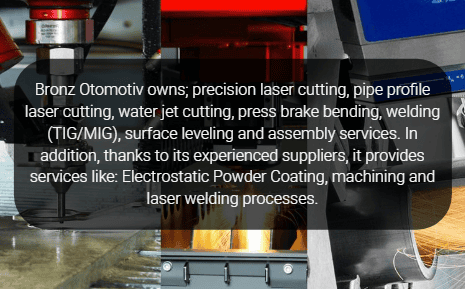
At Bronz Otomotiv, our fiber-laser infrastructure enables us to deliver reliable results in silicon (electrical) steel with tight tolerances, minimal burr formation, and short lead times.
1) Tool-Free, Flexible, and Fast Production – Ideal for Prototypes and Pre-Series
The stamping method requires a dedicated die for every new design.
Die manufacturing is both costly and time-consuming, and any design revision requires re-machining.
Laser cutting, on the other hand, eliminates the need for dies entirely. Once your CAD file is updated, production is immediately synchronized.
This provides key advantages:
- Cost and efficiency are optimized for prototype and pre-series quantities (e.g., 1–500 parts).
- Design changes can be reflected in production within hours — no waiting for tooling revisions.
- Different lamination geometries, interlocking features, slot angles, and ventilation holes can all be tested in a single iteration.
- Total cost of ownership is lower for small batches, since no tooling investment is required.
This flexibility also shortens the product validation cycle.
OEMs and system integrators can complete their Design Validation (DV) and Production Validation (PV) stages more quickly, thus reducing time-to-market.
2) Quality and Performance – Tight Tolerances, Minimal Burrs, and Controlled Thermal Effect
In laser cutting, the kerf (cut width) is narrow and consistent across all parts, enabling tight dimensional tolerances (e.g., diameter precision, slot edge accuracy).
In stamping, tool wear gradually increases burr formation and tolerance deviations, whereas laser cutting eliminates tool wear completely.
At Bronz Otomotiv, we ensure process reliability through:
- Optimized cutting parameters (power, speed, focus, assist gas) based on material thickness and geometry — resulting in minimal burr and smooth edge surfaces.
- Controlled Heat-Affected Zone (HAZ) to preserve the magnetic properties of electrical steel; light deburring and surface finishing steps are applied when necessary.
- High repeatability, ensuring accurate alignment and minimal air gaps during lamination stacking — directly contributing to motor and generator efficiency.
Conclusion
Laser cutting offers speed and flexibility through die-less production, and quality and repeatability through process control.
It reduces total cost, accelerates validation, and gives design teams the freedom to experiment without risk — especially in prototype and pre-series stages.
In automotive, e-mobility, and industrial generator applications, the combination of low burr + tight tolerance + fast lead time makes laser cutting a clear advantage over conventional stamping.